
The short answer
Umbraco CMS is a free, open-source content management system built on modern .NET and ASP.NET Core. It gives editors a back office for managing structured content while giving developers control over the application, integrations, and delivery layer. Around that core, Umbraco HQ offers commercial hosting, SaaS products, support, and official add-ons.
The distinction matters. Umbraco CMS is not a ready-made website, and the wider Umbraco product portfolio is not the same thing as the open-source CMS. The CMS is the foundation. Your team then decides what to build, what to buy, and what to operate.
Umbraco in 60 seconds
Question | Answer |
|---|---|
What is it? | Open-source .NET content management system |
Core stack | C#, ASP.NET Core, modern .NET |
License | MIT for the open-source CMS |
Current LTS generation | Umbraco 17, aligned with .NET 10 |
Traditional website rendering? | Yes, typically with ASP.NET Core MVC/Razor |
Headless? | Yes, through the built-in Content Delivery API |
Hosting | Self-hosted infrastructure or managed Umbraco Cloud |
Best fit | Custom, content-heavy or integration-heavy platforms with a .NET development capability |
Good $500 website builder? | No. A simpler platform is usually a better fit. |
How Umbraco actually works
An editor sees the back office. A developer sees a .NET application with a CMS inside it. Both views are important.
Developers first define the content's shape using Document Types: for example, an Article might include a title, lead, publication date, author, and a collection of content blocks. Editors then create instances of those types without having to understand the underlying database or application code.
The application decides what happens next. Content can be rendered on the server through Razor, exposed as JSON through the Content Delivery API, sent to another channel, enriched with external data, or combined with custom business logic.
For traditional websites, that delivery layer also includes request routing: Umbraco must decide which content item an incoming URL resolves to and whether the request should render content, accept an alternate path, or return a redirect. A concrete example is the set of built-in Umbraco routing properties for URL names, aliases, redirects and internal redirects.
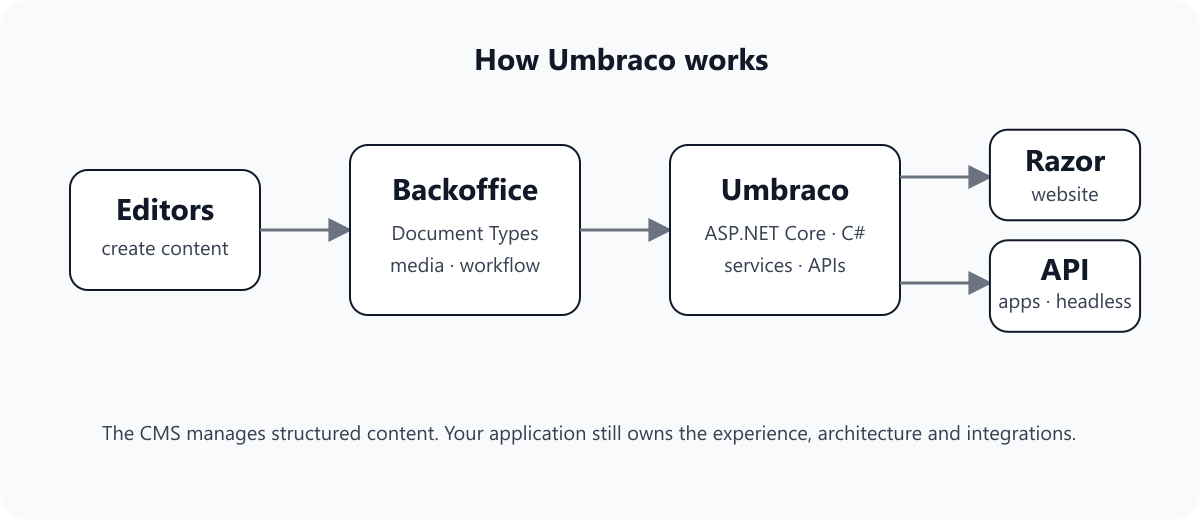
A simplified Umbraco content flow. The CMS manages content; the application still owns delivery and business logic.
This separation is one of Umbraco's biggest strengths. It is also one of its costs. The CMS does not remove the need for architecture.
Umbraco CMS vs the Umbraco product ecosystem
When people say “Umbraco”, they can mean several different things. This is worth clearing up early because it changes how you evaluate features, hosting, and cost.
Umbraco CMS is the open-source foundation. You can self-host it, build your own application around it, and use community or custom packages without buying Umbraco HQ's full commercial stack.
Around the CMS, Umbraco HQ offers managed and commercial products. Umbraco Cloud provides managed hosting and operations for CMS projects. Umbraco Heartcore is a managed headless offering. Official add-ons cover capabilities such as forms, deployment, commerce, personalization, and editorial workflow.
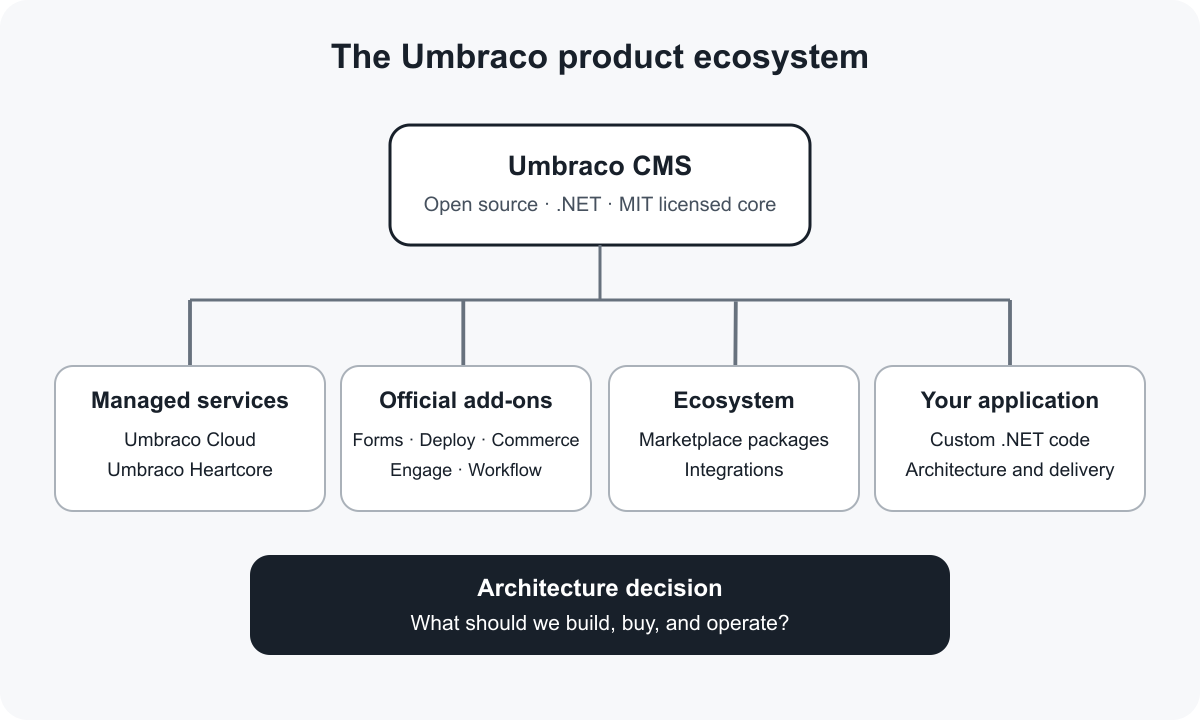
The open-source CMS is the foundation. Managed services, official add-ons, and custom development are choices around that core.
This does not mean every Umbraco project needs those products. A useful architecture question is: should we build this capability, buy a supported product, or operate it ourselves? The answer depends on the team's skills, risk tolerance, time horizon, and total cost of ownership.
Practical rule: do not compare “Umbraco is free” with the price of a complete SaaS platform. Compare the complete operating models you would actually deploy.
What is Umbraco used for?
Technically, you can build a very wide range of systems with Umbraco. That does not mean you should.
In practice, I see the strongest fit where content management is important, but the website is not just content: corporate and multilingual websites, content portals, membership or authenticated experiences, integration-heavy platforms, multi-site estates, and applications where editorial content has to coexist with custom .NET functionality.
Umbraco can also operate headlessly. Its Content Delivery API returns content as JSON, so the presentation layer can be React, Vue, Angular, a mobile application, another service, or something that does not look like a website at all.
Important distinction: “Umbraco can build it” and “Umbraco is the right choice for it” are different statements.
Where Umbraco fits exceptionally well
I would put Umbraco high on the shortlist when several of these conditions are true:
the organization already works in the Microsoft/.NET ecosystem;
the site has non-trivial content modeling, permissions, languages, or editorial workflows;
the solution needs custom APIs or integrations with CRM, ERP, identity, search or internal systems;
the front end must be designed around the product rather than around a pre-built theme;
the platform is expected to live and evolve for years;
a development team will own the codebase and engineering quality matters.
In those projects, Umbraco gives the team a mature content-management layer without forcing the rest of the application into a rigid product model.
When I would not choose Umbraco
This is the section I would want to read before paying anyone to build an Umbraco project.
I would usually not choose Umbraco for a tiny brochure site, a disposable campaign page, a simple personal blog, or a project whose main requirement is “launch tomorrow with no developer”. I would also question it when the organization has no .NET capability and no realistic plan to maintain one.
For a pure e-commerce project, I would first evaluate dedicated commerce platforms. For a visual no-code workflow, I would evaluate tools designed around that operating model. For a simple marketing site, the architectural freedom of Umbraco can be unnecessary cost.
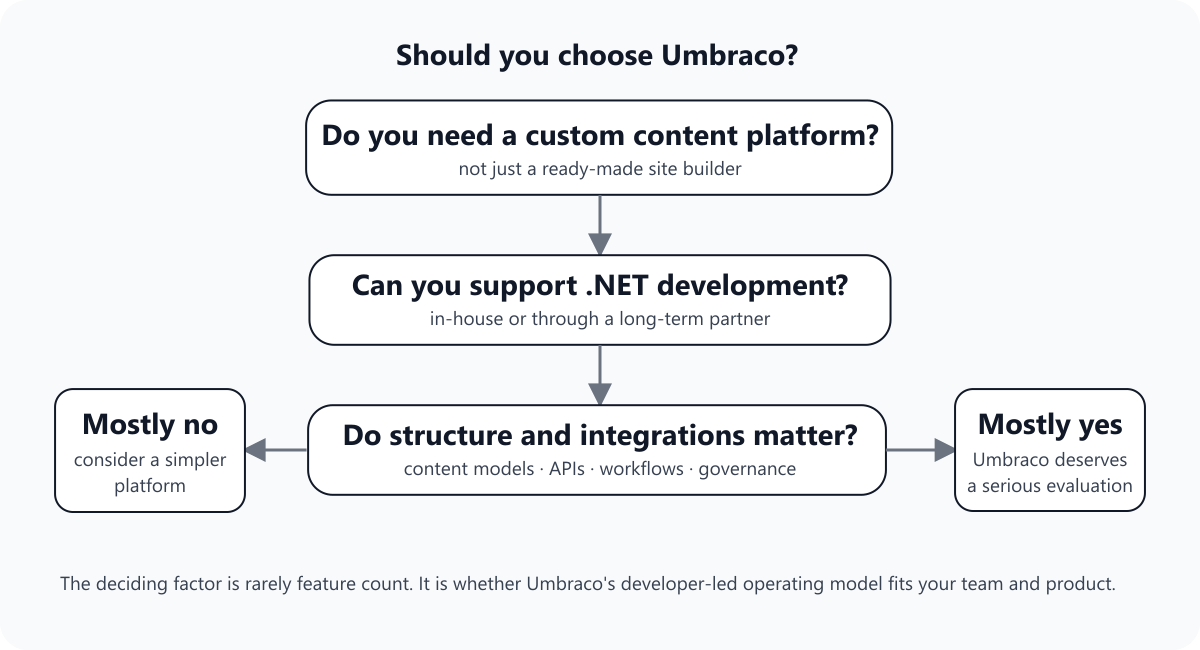
A simple decision filter. Feature count is less important than whether the operating model fits your team.
If you do not need the freedom Umbraco gives you, do not pay for the engineering required to exercise that freedom.
The real advantages of Umbraco
1. You control the application layer
Umbraco does not require your front end to look or behave like an Umbraco site. Your team owns the templates, application code, APIs, and integrations. That matters when requirements are unusual or when the CMS is only one component in a larger digital platform.
2. Structured content is a first-class concern
Document Types make the content model explicit. A good implementation gives editors fields and components that reflect the information they manage, rather than a blank canvas that lets every page become a one-off.
3. It fits naturally into .NET engineering
For a .NET team, Umbraco lives in a familiar ecosystem: C#, ASP.NET Core, dependency injection, configuration, NuGet, automated tests and standard deployment tooling. Umbraco 17 requires .NET 10 or later according to the current official requirements.
4. Traditional, headless and hybrid delivery are all viable
You can render the site in ASP.NET Core, use the Content Delivery API, or mix both. This means “going headless” does not require abandoning the CMS or buying a separate headless product.
5. The core CMS is genuinely open source
The Umbraco CMS repository is public and MIT-licensed. You can self-host the core CMS and extend it in your own application. Commercial products and managed services exist around it, but they are not licensed for the open-source CMS itself.
The real disadvantages and trade-offs
1. You normally need developers
That is not a defect; it is the consequence of the product model. Umbraco gives developers freedom rather than replacing them. If the business expects non-technical users to assemble the entire solution from themes and plugins, expectations are already misaligned.
2. Architectural freedom can produce architectural debt
Umbraco lets teams solve the same problem in many ways. A disciplined team can build a clean platform. An undisciplined team can build a difficult one. The CMS does not protect you from poor content models, excessive custom code, weak caching, bad integrations or missing operational practices.
3. The package ecosystem is smaller than WordPress
That means fewer plug-and-play answers. In return, serious Umbraco projects often implement requirements directly in the application or integrate specialist services rather than stacking dozens of CMS plugins.
4. Upgrades are part of ownership
An actively maintained application needs an upgrade strategy. Dependencies, custom extensions, and integrations have to be tested as the platform and .NET evolve. Treating upgrades as an emergency every few years is a process failure, not a sustainable maintenance model.
5. “Free CMS” does not mean “free platform”
The software license is only one line in the total cost of ownership.
Those trade-offs become much easier to reason about when they are treated as engineering decisions rather than CMS limitations. Why Umbraco Projects Become Expensive examines the failure patterns that make mature platforms harder to change, while Umbraco Technical Debt separates material debt from cleanup that may not justify the cost.
What does Umbraco really cost?
The open-source Umbraco CMS license costs nothing. A professional Umbraco platform does not.
The useful cost model is not simply “free CMS plus hosting”. It is build, buy, and operate.
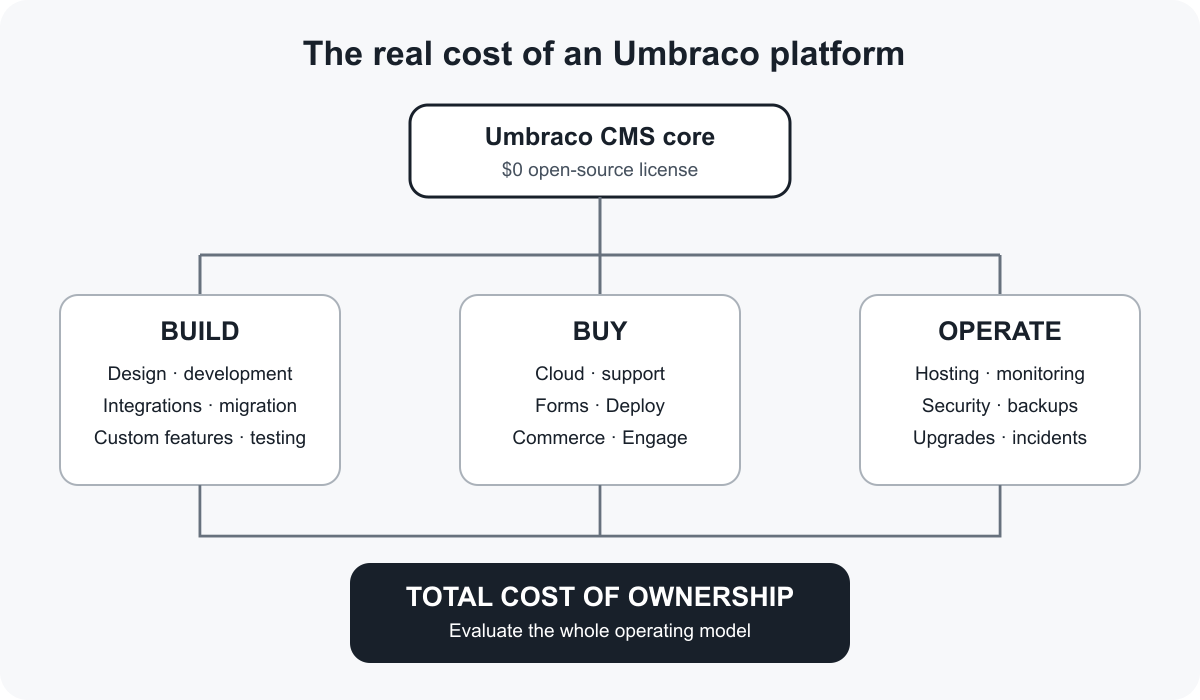
The CMS license is only one line in the economics of an Umbraco platform.
Build
Your team pays for discovery, information architecture, design, implementation, content modeling, integrations, migrations, testing, and custom features. Umbraco gives you freedom here, but that freedom shifts responsibility onto your engineering team.
Buy
You may choose managed hosting, support or official add-ons instead of building equivalent capabilities yourself. Umbraco Cloud, Forms, Deploy, Commerce, Engage and Workflow can reduce specific implementation or operational burdens, but they change the commercial model.
Operate
Someone still owns hosting, monitoring, backups, security, deployments, incident response, upgrades and ongoing maintenance. With self-hosting, more of that responsibility sits with your team. Managed products can move part of it to the vendor.
So I would never select Umbraco because “the CMS is free”. I would select it when the combination of technical freedom, editorial capability, and lifetime operating model makes sense for the system we actually need.
Umbraco vs WordPress, Drupal and headless SaaS
A full comparison deserves separate articles. For the initial decision, this is enough:
If your priority is... | I would investigate first... |
|---|---|
Fast launch, huge theme/plugin ecosystem, low entry barrier | WordPress and managed website builders |
Custom .NET application + strong content management | Umbraco |
Large open-source CMS with a different enterprise ecosystem | Drupal alongside Umbraco |
API-first content with minimal CMS hosting responsibility | Headless SaaS products alongside Umbraco's Delivery API |
Commerce is the product | Dedicated commerce platforms first; integrate a CMS if needed |
The mistake is asking which CMS is “best”. The useful question is: which constraints do you want your CMS to remove, and which responsibilities are you prepared to own?
My assessment after years of working with Umbraco
I have worked with Umbraco across multiple generations of the platform. The biggest lesson is that the CMS itself is rarely the limiting factor.
Two companies can both say “we use Umbraco” and operate systems of completely different quality. One may have a coherent content model, automated deployments, tested integrations, an upgrade path and predictable performance. The other may have accumulated years of one-off templates, abandoned packages and business logic nobody wants to touch.
Umbraco's flexibility amplifies engineering decisions. Good architecture becomes an asset because the CMS stays out of the way. Poor architecture also survives remarkably well because the CMS gives you enough freedom to keep adding to it.
That is why I think of Umbraco less as a box of website features and more as a content platform inside a .NET application. This mental model leads to better decisions about content modeling, integrations, testing, deployment, and ownership.
If your organization needs that level of control, Umbraco can be an excellent long-term foundation. If it does not, choosing something simpler is not a downgrade. It is good architecture.
How I would evaluate Umbraco for a new project
Start with the operating model. Who edits content, who owns code, and who maintains the platform?
Model the difficult content. Do not evaluate a CMS using only a Home Page and Contact Page.
List integrations and non-content requirements. Identity, search, CRM, commerce and external data often determine architecture.
Decide how content will be delivered. Server-rendered, headless or hybrid.
Estimate lifetime ownership. Include upgrades, hosting, observability and maintenance, not only initial build cost.
Prototype the risky part. A small proof of concept around the hardest integration or editorial workflow is more useful than a generic feature checklist.
Frequently asked questions
Is Umbraco free?
Yes. The core Umbraco CMS is open source under the MIT license. Hosting, development, commercial add-ons, managed cloud products, and support can still cost money.
Is Umbraco a framework or a CMS?
Umbraco is a CMS built on .NET. Developers sometimes describe it as framework-like because it is highly extensible and becomes part of a custom application, but calling it a CMS is the clearest and most accurate starting point.
Does Umbraco use .NET?
Yes. Modern Umbraco is built on ASP.NET Core and C#. Umbraco 17 aligns with .NET 10.
Can Umbraco be headless?
Yes. The built-in Content Delivery API can expose published content as JSON for other front ends and channels. It is opt-in and must be enabled.
Does Umbraco require SQL Server?
Not for every scenario. The current official requirements document both SQLite and SQL Server options. Production architecture should be chosen based on the actual workload and hosting model.
Is Umbraco better than WordPress?
Not universally. WordPress is often a better fit when low entry cost, rapid setup, and a huge plugin/theme ecosystem are priorities. Umbraco becomes more compelling when a .NET team needs custom architecture, structured content, and integrations.
Is Umbraco suitable for enterprise projects?
Yes, but “enterprise” is not a feature switch. Umbraco can support complex content platforms; the implementation still needs appropriate architecture, security, operations, governance, and engineering practices.
References
Umbraco CMS on GitHub — source code and license
Umbraco CMS — official CMS positioning and product overview
Umbraco Cloud — managed hosting and operations
Umbraco Heartcore — managed headless CMS offering
Umbraco Forms — official forms add-on
Umbraco Deploy — official deployment engine
Umbraco Documentation: Content Delivery API — headless content delivery


