
That distinction matters because mature systems accumulate imperfections faster than any team can remove them. Some slow every release. Some hide production risk. Some block an upgrade. Others are simply old, unfashionable or awkward and may be cheaper to leave alone.
The goal is not to eliminate technical debt. The goal is to keep the platform economical to change without spending more on cleanup than the underlying problem is worth.
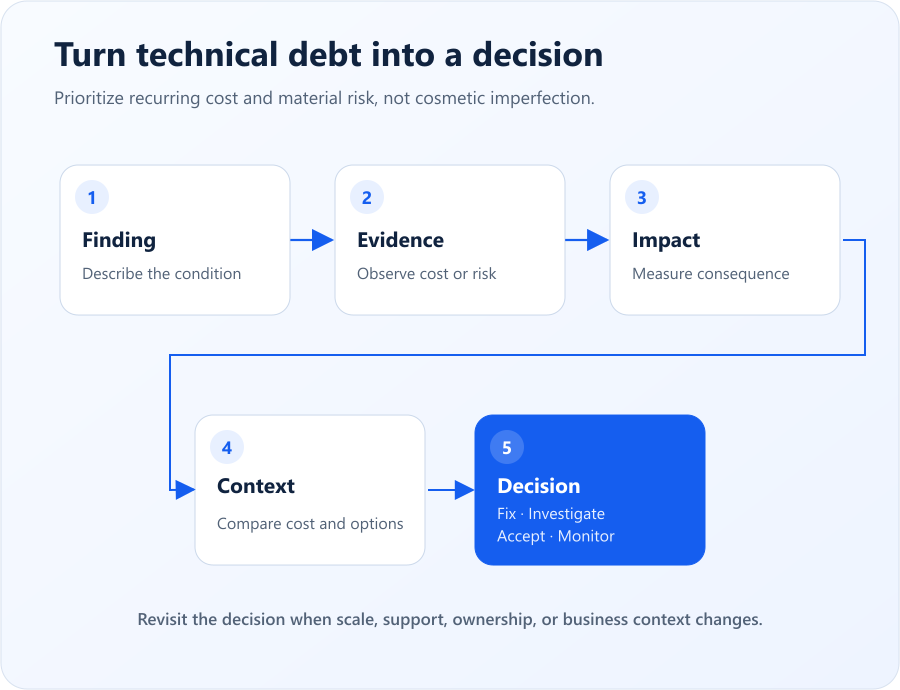
Technical debt decision model. Begin with a specific condition, establish evidence and impact, then compare the cost of carrying it with the cost and risk of change. The outcome is an explicit decision to fix, investigate, accept or monitor.
Technical Debt Is a Cost Model, Not a Cleanliness Score
If every imperfect implementation is labeled technical debt, the term stops helping with decisions. Mature Umbraco platforms contain old naming, duplicated code, obsolete conventions, awkward content models, temporary integrations that became permanent and customizations nobody would design the same way today. Some of those conditions are expensive. Some are merely unattractive.
I use technical debt as a decision concept: a technical condition that creates a recurring cost, material risk or loss of useful future options. A messy class that nobody changes may have almost no economic effect. A small coupling that taxes every release can be much more important.
A useful debt statement therefore has three parts: the technical condition, the cost or risk it creates, and the context that makes that consequence material. Condition → Carrying cost → Context. Without all three, “technical debt” is often just a preference disguised as architecture.
Do not confuse defects with debt
A defect is behavior that is wrong relative to a requirement. Technical debt is a condition that changes the cost or risk of maintaining the system. They can overlap, but treating every bug as debt makes prioritization less clear. A broken checkout is a defect that may need immediate correction even if the underlying code is elegant. A fragile integration boundary may be debt even while every current request succeeds.
Start With the Cost the Debt Creates
Before proposing refactoring, I ask what the current design makes harder. Does it increase incident frequency? Does every feature require touching five unrelated layers? Does publishing slow down as the tree grows? Does a package block a supported upgrade? Does environment-specific configuration make releases risky? Does the team avoid a component because nobody understands its failure behavior?
This converts debt from an aesthetic judgment into an observable consequence. If we cannot describe the cost, the next step is usually Investigate rather than Fix.
Evidence of carrying cost | What it can tell you |
|---|---|
Change history | Whether ordinary features repeatedly touch the same fragile boundary. |
Incident history | Whether the condition already contributes to operational cost. |
Runtime measurements | Whether cost grows with rows, content, traffic or dependency latency. |
Upgrade discovery | Whether a dependency creates a deferred cost with a deadline. |
Developer workflow | Whether knowledge concentration or manual steps create a repeated tax. |
Look for technical debt interest, not just principal
The implementation cost of removing debt is the principal. The recurring penalty paid while keeping it is the interest. In software that interest rarely appears as one invoice. It appears as repeated engineer time, release friction, incidents, slower onboarding, upgrade preparation and operational uncertainty.
Observed interest | Evidence | What would make it material? |
|---|---|---|
Change tax | Ordinary features repeatedly touch the same fragile boundary. | High change frequency or large regression surface. |
Operational tax | Incidents, manual recovery or repeated support work. | Material frequency, duration or business impact. |
Upgrade tax | A dependency or customization blocks the supported path. | Approaching support deadline or strategic upgrade. |
Scale tax | Cost grows with rows, nodes, traffic or external calls. | Observed growth is approaching a known threshold. |
Knowledge tax | Only one person can safely change or operate the component. | High business criticality or ownership risk. |
This gives the discussion a better question than “how bad is the code?”: what interest are we paying, how often, and is it increasing?
Four Decisions Are Enough for Most Findings
I classify findings as Fix, Investigate, Accept or Monitor. The categories are deliberately operational. They describe what should happen next, not how embarrassing the implementation looks.
Decision | Use it when | What should be recorded |
|---|---|---|
Fix | Evidence shows material recurring cost or unacceptable risk, and a reasonable correction exists. | Expected benefit and how the change will be verified. |
Investigate | The mechanism looks risky but evidence is insufficient to justify a change. | The missing evidence and the smallest useful investigation. |
Accept | The cost is understood and lower than the cost or risk of changing it. | Why carrying the condition is currently rational. |
Monitor | The condition is tolerable now but could become material as scale, traffic or dependencies change. | The threshold or event that should trigger review. |
A finding can move between categories as evidence changes. That is a feature, not inconsistency. Technical debt is contextual. That evidence-first classification is the same decision model I use when auditing an existing Umbraco project.
The Debt I Prioritize
Debt that taxes every change
Some debt behaves like a transaction fee on development. A content model may require coordinated changes across templates, APIs and import jobs. A shared helper may hide multiple unrelated responsibilities. A deployment may require manual steps known by one person. Each individual change still succeeds, but lead time and regression risk are consistently higher.
This is the debt I prioritize even when it has not caused a production incident. Version-control history, incident records and developer workflow can reveal the repeated cost better than static code analysis. The same recurring costs show up at platform level in the technical failure patterns that make Umbraco projects expensive.
Debt at architecture boundaries
I pay particular attention to boundaries used by many features: content access abstractions, integration clients, shared rendering components, deployment conventions, authentication, search and configuration. Debt at a boundary can multiply across the platform because every consumer inherits it.
Conversely, ugly code inside a well-contained feature can be cheap to carry. Raw code-quality metrics struggle with this distinction because they count local imperfections without understanding architectural leverage.
Observability debt
Swallowed exceptions, unstructured logs and missing dependency timings may not directly break a feature. They increase the cost of every future incident because the team has less evidence. Observability debt often has unusually high leverage: improving evidence around a critical job or integration can reduce investigation time across many future failures.
Upgrade blockers
A dependency on an abandoned package, obsolete framework or unsupported extension point may have little day-to-day cost until the platform must upgrade. At that point the deferred cost becomes immediate. I treat a genuine upgrade blocker as debt with a deadline. The priority depends on support windows, exposure and how much discovery is needed to replace the dependency. When that deadline becomes concrete, Umbraco upgrade readiness provides the wider dependency, verification and ownership context for the decision.
The Debt I Investigate or Monitor
Latent production risk
Some debt is quiet until a threshold is crossed. Unbounded data retrieval may work for years and then become expensive as a table grows. Broad content traversal may be harmless on a small site and become a hot-path problem after a migration. A background job may be fine at low volume and later compete with user traffic.
The useful move is to identify the scaling variable and make it observable. If cost grows with row count, tree size, request rate or dependency latency, define a threshold for action instead of refactoring from fear.
Security-sensitive conditions
Security findings need a different risk lens from code cleanliness. Secrets stored in editable content, obsolete dependencies, excessive permissions and insecure defaults can have low change frequency but high consequence. Evidence includes exposure, exploitability, compensating controls and sensitivity of the affected system.
An engineering review can identify boundaries and obvious weaknesses, but it should not pretend to be a penetration test or prove the absence of exploitable vulnerabilities.
Umbraco Content Architecture Can Carry Technical Debt
Technical debt in Umbraco is not confined to C#. Fixed content IDs, tree-position assumptions, duplicated document types, overloaded block models and editor workflows encoded only in convention can all increase the cost of change. These structures are architecture because application behavior depends on them.
A fixed picker root is a useful example. If it is stable by design and identical across environments, it may be acceptable. If deployments regularly recreate content with different identifiers, the same configuration becomes environment coupling. The implementation alone does not determine the decision.
Content Tree Coupling is not automatically a defect. It becomes material when content movement, environment recreation or reuse can break behavior outside the editor's visible scope.
A Finding Can Contain Several Debt Types
Real findings often decompose. A background job that loads an entire table, reads credentials from content, performs synchronous I/O and swallows exceptions is not one blob of “bad code.” It contains scaling debt, security-boundary debt, latency/failure debt and observability debt. Each part can have a different next action.
Decomposition prevents severity inflation. The whole implementation may look alarming, but perhaps the data volume is tiny and the job runs monthly. Or perhaps the same job processes millions of rows every two minutes. Evidence changes the decision.
Signal | Question | Possible decision |
|---|---|---|
Unbounded data retrieval | How does work grow with the source dataset? | Fix or Monitor |
Credentials in content | Who can read/change them and what is the exposure? | Fix |
Synchronous external I/O | Is it on a critical path and what happens when the dependency slows? | Investigate or Fix |
Swallowed exceptions | Can a material failure happen without actionable evidence? | Fix |
Worked example: from ugly code to an engineering decision
Consider an illustrative background job that wakes every two minutes, materializes an entire history table, filters it in memory, reads credentials from editable content, calls an external service synchronously and catches exceptions without a durable failure signal.
Calling the whole implementation “high technical debt” is not useful. I would decompose it and collect evidence:
Condition | Evidence to collect | Possible decision |
|---|---|---|
Whole-table retrieval | Row growth, rows read, memory and job duration. | Fix if cost grows materially; otherwise Monitor with a threshold. |
Credentials in content | Who can read/change them, environment behavior and exposure. | Fix when the boundary creates unacceptable security or operational risk. |
Synchronous external call | Dependency latency, timeout behavior and whether the job blocks useful work. | Investigate before changing the execution model. |
Swallowed exceptions | Whether failures are currently detectable and recoverable. | Fix if silent failure can invalidate the job's outcome. |
The important point is that one code path can legitimately produce several decisions. Debt review is not a severity contest. It is decomposition followed by evidence.
Decide Whether Refactoring Pays Back
For a proposed fix I compare the carrying cost of the current condition with the cost and risk of changing it. The numbers do not need false precision. I want enough information to compare options: frequency of affected changes, incident history, engineer time, support deadlines, scaling trend and blast radius.
A simple payoff test
I use a deliberately rough comparison rather than fake financial precision:
Expected carrying cost over the decision horizon > Cost + risk of change
The horizon matters. A boundary touched every sprint on a platform expected to live for five years can justify substantial work. The same refactor in a feature scheduled for retirement may never pay back. When the two sides are close, a smaller containment change can be better than a rewrite.
A refactor with a two-year theoretical payoff may be sensible in a platform expected to run for ten years. The same work may be wasteful in a system scheduled for retirement in six months. Context is part of the technical decision.
Ugly but stable code can be accepted
If code is isolated, well understood, rarely changed and has no material operational cost, rewriting it may have negative return. The new implementation introduces regression risk and consumes capacity without improving an important system property.
Accept does not mean “good.” It means the team has consciously decided that the existing condition is cheaper to carry than to remove.
Duplication can be cheaper than coupling
Repeated code is not automatically debt worth removing. Two similar features can have different reasons to change. A shared abstraction that forces them to evolve together can cost more than a small amount of duplication. The relevant question is not “can this be DRY?” but “what future change does this abstraction make cheaper or more expensive?”
Turn Accepted Debt Into Review Conditions
Accepted debt should have a condition that causes the decision to be revisited. “Accept until this feature is replaced,” “Monitor while the table remains below this growth threshold,” or “Investigate before the next major upgrade” is much more useful than a ticket that sits in a backlog indefinitely.
A fixed content ID may be harmless while environments are cloned from one source. If the organization moves to independent content deployment, the same assumption becomes expensive. A package may be acceptable while supported and become an upgrade blocker when maintenance stops. The technical condition did not necessarily change, but its context did.
Review conditions are more useful than permanent severity. They tell the team exactly what change in context should reopen the decision.
Keep the Technical Debt Register Small Enough to Use
Manage a debt portfolio, not a cleanup backlog
A useful register contains only conditions that can affect an engineering decision. I want to be able to answer three questions at a glance: what is costing us now, what could become expensive later, and what have we deliberately accepted?
Portfolio bucket | Typical treatment | Planning behavior |
|---|---|---|
Active cost | Fix or contain. | Competes for delivery capacity because evidence shows current cost. |
Uncertain risk | Investigate. | Buy the smallest amount of evidence needed for a decision. |
Threshold risk | Monitor. | Attach a measurable trigger instead of scheduling speculative work. |
Deliberate debt | Accept. | Record why carrying it is rational and when that decision expires. |
I do not want a register with 600 lint findings. For strategic debt I record the condition, evidence, current impact, scaling or trigger variable, decision, owner and review condition. The register should help planning, architecture and upgrades, not become another abandoned backlog.
Field | Example |
|---|---|
Condition | Background job materializes full history before filtering. |
Evidence | Query path and row count show work grows with the complete table. |
Impact | Increasing memory, database and job-duration cost. |
Decision | Fix. |
Verification | Bounded query, reduced rows read and stable job duration as history grows. |
Review condition | Not required after verified fix. |
Failure patterns compress experience, not analysis
Stable names for recurring mechanisms help teams recognize them quickly. Unbounded Data Retrieval tells me to look for work that grows with the source dataset. Content Tree Coupling tells me to inspect assumptions about IDs and positions. Silent Failure tells me to inspect what happens when an operation fails and whether anyone can observe it.
The name is only an index into reasoning. Seeing a pattern should trigger evidence collection, not an automatic refactor. A pattern library can accelerate review, but context and impact still determine the decision.
Three Technical Debt Mistakes I Avoid
Turning static analysis into a debt register
Analyzer warnings and code smells can be useful signals, but they do not establish carrying cost. Promote them into strategic debt only when evidence or context makes them relevant to a real decision.
Using a single severity score
A universal score hides context. A low-frequency security boundary and a high-frequency change tax can both matter for completely different reasons. I prefer evidence, impact, decision and review condition over one synthetic number.
Creating a permanent “20% debt sprint”
A fixed cleanup quota can fund low-value refactoring while important architectural debt remains untouched. I would rather connect debt work to demonstrated carrying cost, upcoming platform changes, support deadlines and measurable risk.
Connect Technical Debt to Platform Strategy
Debt decisions should reflect where the platform is going. If Umbraco is becoming a long-lived enterprise content platform, investments in boundaries, observability, deployment and upgradeability have a longer payoff horizon. If a feature is being retired, the correct strategy may be containment rather than modernization.
I connect debt review to roadmap questions: which capabilities will grow, which integrations are strategic, which content models will receive more variants, which parts are likely to be replaced and which support deadlines are approaching. This changes priority more than a static severity label.
The result is a portfolio of deliberate decisions. Some debt is removed because it blocks the future. Some is contained because it sits in a declining area. Some is monitored because scale may expose it later.
Final Perspective
The mature approach to technical debt is selective. Fix what creates material recurring cost or unacceptable risk. Investigate what looks dangerous but lacks evidence. Accept what is cheaper to carry. Monitor what may become expensive as the platform changes.
That is stronger engineering than either extreme: “refactor everything” or “if it works, never touch it.” The job is to preserve the platform's ability to change without spending more on cleanliness than the business problem is worth.
The unit of technical debt is not ugliness. It is constrained change. The strongest debt work makes future change cheaper, safer or more predictable, and can show why that improvement is worth buying now.
Frequently Asked Questions
Is all legacy Umbraco code technical debt?
No. Age is not a cost model. Old code can be stable, supported and inexpensive to change. I treat a condition as meaningful debt when it creates recurring cost, material risk or loss of useful future options.
Should every technical debt finding be fixed?
No. A useful review can end in Fix, Investigate, Accept or Monitor. Accept is appropriate when the cost is understood and cheaper to carry than to remove. Monitor is appropriate when a clear threshold or future event could change the decision.
What is the difference between a defect and technical debt?
A defect is behavior that is wrong relative to a requirement. Technical debt is a technical condition that changes the cost or risk of maintaining the system. They can overlap, but they are not the same prioritization problem.
Are upgrade blockers technical debt?
They can be. A package, obsolete API or unsupported extension point may have little daily cost but create a deferred cost with a deadline when the platform must upgrade. That makes upgrade readiness an important lens for debt review.


